
Tuscaloosa County Criminal Case Files
A Tuscaloosa County criminal court record begins when a criminal matter is filed with the court. Circuit Clerk Magaria H. Bobo is the official record keeper for District and Circuit Court proceedings. The Criminal and Warrant divisions maintain pleadings, notices, orders, bonds, fines, costs, and case events. A file may show several charges, but each count must be followed through its own disposition. An accusation at filing is not proof of guilt.
District Court handles limited-jurisdiction criminal matters and preliminary activity. Circuit Court is the Sixth Judicial Circuit's general-jurisdiction trial court and handles felony proceedings. Tuscaloosa and Northport Municipal Courts separately handle city ordinance offenses and certain misdemeanors. District Attorney Hays Webb's office prosecutes local cases, while the Circuit Clerk keeps the official court record.
The prosecution office and clerk have separate records roles in the same criminal case.
Search Tuscaloosa County Criminal Records
Alacourt ACCESS and Just One Look provide on-demand Alabama trial-court information, including criminal cases. Access is fee-based or account-based, not a free unlimited index. The free Tuscaloosa County docket search is best for hearing settings. It searches county 63 by setting date and optional last name, but warns that some cases may not appear.
- Identify the Circuit, District, Tuscaloosa Municipal, or Northport Municipal Court venue.
- Use Alacourt for case information or the county docket for a scheduled hearing.
- Match the defendant, case number, court, and division before relying on a result.
- Read each charge, plea, order, disposition, and sentence as a separate entry.
- Ask the Circuit Clerk for a certified copy when an authenticated record is needed.
The clerk counter is the fallback for complete documents, older files, certified copies, or a case missing online. Alapay accepts eligible disposed criminal balances, but its payment screen is not a full case record. For focused charge details, use the Tuscaloosa arrest and court-charge pathway.
Tuscaloosa County Criminal Case Stages
A felony matter may have early District Court activity before an indictment and Circuit Court case. Lower-level matters may stay in District or Municipal Court. Each stage creates docket text or a filed document. Dates can shift through continuances, so the newest setting and order matter more than an old notice.
Case flow: Charges Filed › Arraignment › Pretrial / Motions › Plea or Trial › Disposition › Sentencing
Arraignment records the plea. Pretrial entries show motions, notices, responses, and hearing orders. A plea or trial leads to the disposition. Sentencing may include confinement, probation, restitution, fines, costs, and other terms in several entries.
What Tuscaloosa County Criminal Records Show
The file joins identity, court, charge, and outcome data. Tuscaloosa County's location code may appear as 63 in an Alacourt case number. A case may list several counts that end differently. Filing, hearing, and disposition dates also serve distinct purposes.
| Field | What It Shows |
|---|---|
| Case Number | The court identifier, often showing county code, case class, year, and sequence. |
| Defendant | The person accused in the filed case. |
| Charges | Each alleged offense and later amendment, reduction, or dismissal. |
| Plea | The defendant's formal response, such as guilty or not guilty. |
| Disposition | The current or final result for each charge. |
| Sentence | Confinement, probation, restitution, fines, costs, and other terms. |
Tuscaloosa Charges and Convictions
A charge is an allegation. A conviction follows a guilty plea or verdict. Tuscaloosa County criminal records can preserve charges that were amended, dismissed, not prosecuted, or resolved by a not-guilty verdict. Check the disposition count by count, then read a sentence only when a conviction exists.
| Charge | Conviction | |
|---|---|---|
| Stage | Accusation | Verdict or plea |
| Burden of Proof | Probable cause | Beyond reasonable doubt |
| Meaning | Shows what was alleged | Shows guilt established by plea or verdict |
Read Tuscaloosa Criminal Outcomes
Disposition is the current or final outcome. Dismissed means the court ended that count without conviction. Nolle prosequi means the prosecutor declined to continue that charge at that point. Pending means no final result has been entered. Sentence fields should be read with the judgment and later orders because probation, restitution, fines, costs, and confinement may appear on separate lines.
The official Hays Webb biography identifies the Sixth Judicial Circuit District Attorney.
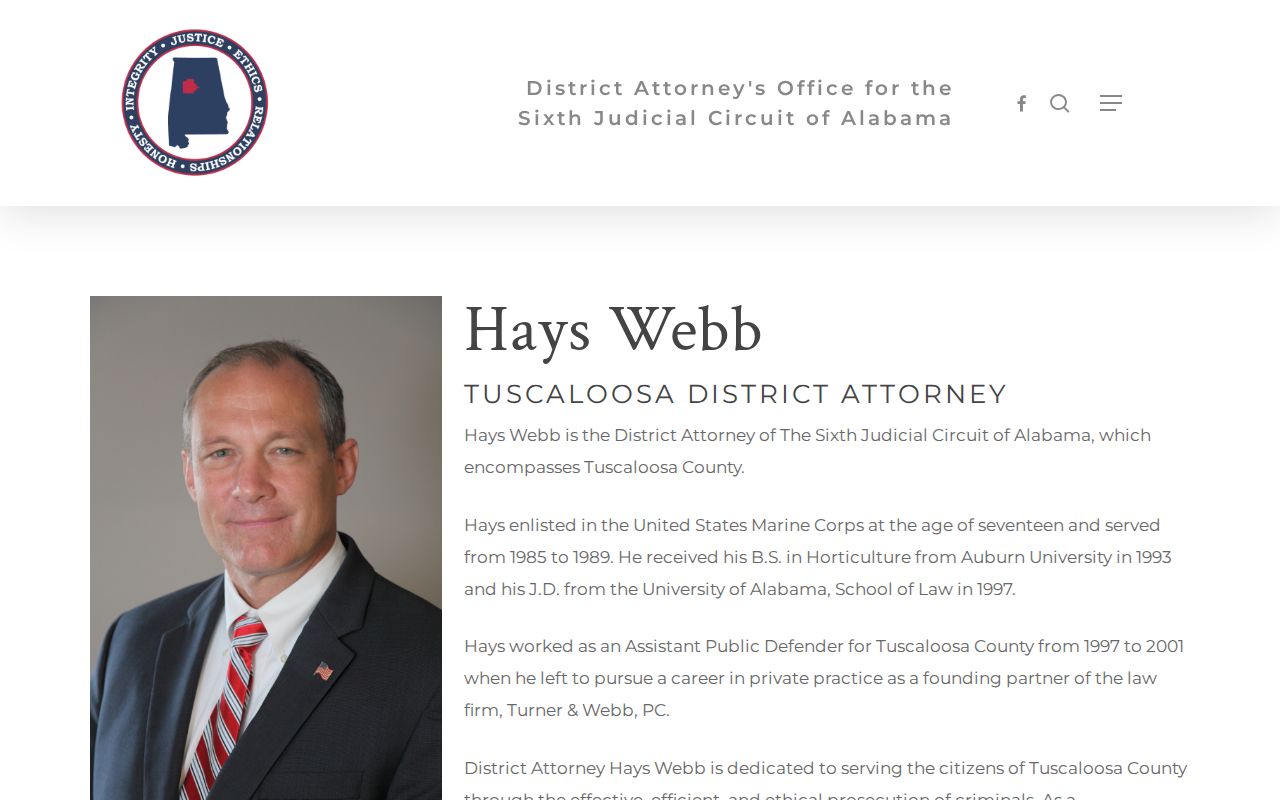
The prosecutor may explain agency records, but the court disposition remains in the clerk-held file.
Tuscaloosa Sealed and Expunged Records
Sealing and expungement both limit public access, but they are not identical. Alabama expungement is a statutory court process for eligible records. A person files in the criminal division of Circuit Court where the charge was filed, using AOC Form CR-65 and required certified arrest, disposition, and ALEA criminal-history documents. Eligibility depends on the charge, result, waiting period, history, and statutory category.
| Sealed | Expunged | |
|---|---|---|
| Visibility | Restricted by law or court order | Removed from ordinary public access under Alabama law |
| Authority | Law, rule, or sealing order | Alabama Code section 15-27-1 et seq. and court order |
| Local path | Ask the Circuit Clerk what access is allowed | File an eligible petition in Circuit Court's criminal division |
Public Tuscaloosa Criminal Court Records
Alabama law supports inspection of public writings, while court rules preserve access to open court files. Limits apply to juvenile and youthful-offender material, identifiers, sealed or expunged records, grand-jury material, unexecuted warrants, and open investigations. Online absence does not prove no case exists. It may reflect timing, age, indexing, or a lawful restriction.
Key authorities:
Alabama Code sections 36-12-40 and 36-12-41 support inspection and copying of public writings, subject to exceptions.
Alabama Rule of Judicial Administration 30 governs open court files, copies, certified copies, and restricted records.
The DA public-records form is a separate agency-record channel and requires contact data, request details, purpose, and government ID.
Use the DA form for prosecution records, not instead of a certified copy from the Circuit Clerk.
Tuscaloosa Criminal Records and Defense
People accused in District, Circuit, Tuscaloosa Municipal, or Northport Municipal Court may receive an appointed public defender when the court finds they cannot afford counsel. Defense files and attorney communications are not the public court docket. Counsel can interpret a pending charge, bond condition, plea, sentence, or expungement question.
Important: Public case data here cannot be used as an FCRA consumer report for employment, housing, credit, or insurance.
The Tuscaloosa County Office of Public Defender describes its client-centered mission.

The office serves court-appointed clients in county and municipal criminal matters.
Joseph P. Van Heest's official profile identifies the appointed Public Defender.

His office is a defense channel, while official case copies remain with the Circuit Clerk.
Restricted Tuscaloosa Criminal Court Records
Juvenile identifying information is confidential, and certain juvenile files may be sealed. Youthful-offender data also receives special protection. Social Security and driver-license numbers are redacted. Grand-jury material, unexecuted warrants, open investigative records, medical information, and sealed or expunged files may be withheld. Rule 30 does not override these restrictions.
Contact the Circuit Clerk at 714 Greensboro Avenue, Room 214, Tuscaloosa, Alabama 35401, or (205) 464-8259 for a missing file, certified copy, or access question. Hours are 8:00 am to 5:00 pm, Monday through Friday. Ask whether a written request is needed and what current fee applies.
A court-file request should name the defendant, case number if known, court level, and specific document. The clerk's local fee page does not publish a full current fee schedule and tells users to call the office. Rule 30 permits a fee and may allow the clerk to require a written request. A docket printout may help locate a case, but it is not the same as a certified complaint, indictment, order, judgment, or case-action summary.
The court level also affects what the file contains. District Court records can show lower-level criminal proceedings, traffic matters, and preliminary felony activity. Circuit Court records can show the felony prosecution after indictment, trial or plea, and sentencing. A Tuscaloosa or Northport Municipal Court file belongs to that city court even if the defendant was booked into the county jail. The courthouse clerk cannot be assumed to hold the municipal file.
Several terms help resolve apparent conflicts. A continuance moves a hearing without ending the case. A motion asks the judge to act. An order records the judge's direction. A bond governs release while the case is pending. Restitution is repayment ordered to a victim. Probation is supervision imposed instead of or after confinement. Each item can appear on a different docket line, so the complete sequence matters.
For a prosecution-agency request, the DA form asks for enough detail to locate the record and requires a government ID upload. The office may deny or redact material covered by its listed exceptions. For a defense question, appointed counsel or private counsel can address legal meaning. For the official court result, the Circuit Clerk remains the source to verify.